Kyocera Connector Technology & Engineering

Decades of materials science expertise applied to the science of reliable interconnection. Explore the engineering principles behind every Kyocera connector.

Core Technology Platforms

Proprietary processes and materials that translate directly into measurable performance advantages.
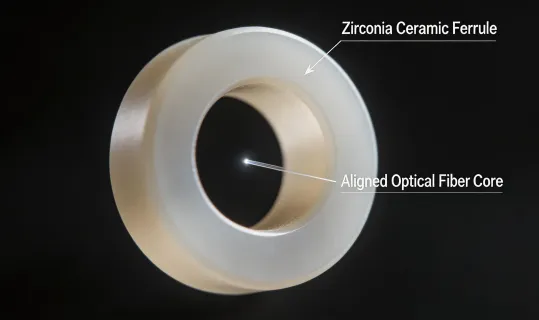
Ceramic Ferrule Manufacturing

Fine Ceramic Ferrule Manufacturing

Our proprietary zirconia ceramic formulation achieves a Vickers hardness of 1,200 HV with controlled grain structure below 0.3 μm. This translates to ferrule endface geometry within IEC 61300-3-15 Grade A specifications: radius of curvature 10-25 mm, apex offset ≤ 50 μm, and fiber protrusion -50 to +50 nm.

Each ferrule blank is precision-ground and lapped in automated multi-stage processes, achieving dimensional tolerances of ±0.005 mm on the ferrule outer diameter. This level of precision ensures consistent physical contact across every mating cycle.
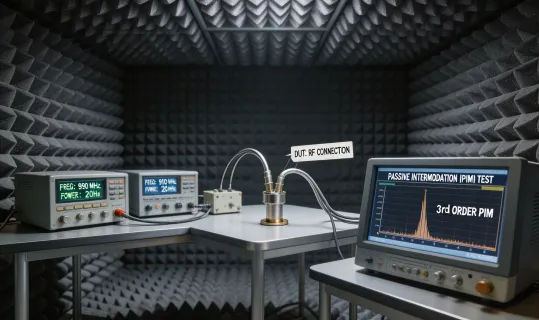
PIM Testing

Passive Intermodulation (PIM) Testing

Passive intermodulation is the generation of unwanted signals when two or more carrier frequencies pass through a non-linear junction — a critical concern in multi-carrier 4G/5G base station environments. Our in-house PIM test facility operates at -160 dBc sensitivity, exceeding IEC 62037 requirements.

Every RF connector design undergoes PIM characterization across the full specified frequency range before production release. Manufacturing processes are controlled to prevent ferromagnetic contamination and ensure consistent contact plating thickness.

Performance Specifications

Key parameters across our connector product families, tested per applicable IEC, MIL, and TIA standards.

Parameter Fiber (SM) Fiber (MM) RF (SMA) RF (N-Type)
Insertion Loss ≤ 0.15 dB ≤ 0.20 dB ≤ 0.10 dB @ 18 GHz ≤ 0.08 dB @ 6 GHz
Return Loss ≥ 55 dB ≥ 30 dB ≥ 26 dB ≥ 30 dB
Operating Temp. -40°C to +85°C -40°C to +85°C -55°C to +125°C -55°C to +125°C
Mating Cycles ≥ 500 ≥ 500 ≥ 5,000 ≥ 5,000
IP Rating IP67 (outdoor) IP67 IP68

Standards & Compliance Framework

Products designed, manufactured, and tested against international standards for global market access.

Fiber Optic Standards

  • IEC 61300 — Fiber Optic Interconnecting Devices
  • IEC 61753 — Fiber Optic Performance Standard
  • TIA-568 — Commercial Building Cabling Standard
  • Telcordia GR-326 — Single-Mode Fiber Connectors

RF & Environmental Standards

  • IEC 62037 — PIM Measurement Method
  • MIL-STD-810G — Environmental Engineering
  • MIL-STD-1344 — Connector Test Methods
  • IEC 60529 — IP Protection Ratings

Quality & Environmental

  • ISO 9001:2015 — Quality Management System
  • IATF 16949 — Automotive Quality Management
  • ISO 14001:2015 — Environmental Management
  • RoHS / REACH Compliance

Connector Selection: Performance Trade-Offs

Every connector technology involves trade-offs. Understanding these boundaries is essential for correct specification.

Fiber Optic vs. Copper Connectivity

Fiber optic connectors deliver future-proof bandwidth capacity (100G/400G and beyond), lower long-term maintenance costs, and superior latency for next-generation applications. However, fiber deployments require higher upfront installation costs, specialized fusion splicing equipment, and trained technicians. For short-reach applications under 100 meters, enhanced copper solutions using Cat6A or G.fast technology may provide sufficient bandwidth at lower initial cost, particularly when leveraging existing copper infrastructure.

Kyocera provides both fiber and copper-compatible connector solutions, and our application engineers can assist in evaluating the total cost of ownership for each approach based on your specific deployment scenario.

Active Optical Networks (AON) vs. Passive Optical Networks (PON)

AON architectures provide dedicated bandwidth per user and reach distances up to 80 km, simplifying troubleshooting with active monitoring at each node. PON architectures use unpowered splitters, resulting in lower operational costs and simpler outside plant design — advantages that scale in high-density residential deployments. Our PON-grade splitter connectors achieve ≤ 0.15 dB insertion loss, while AON-compatible transceiver connectors support extended temperature ranges for active cabinet environments.

The optimal architecture depends on subscriber density, available fiber count, and operational budget. Neither approach is universally superior.

Ceramic vs. Metal Ferrules

Zirconia ceramic ferrules provide superior dimensional stability and lower insertion loss over temperature cycling. However, ceramic is more brittle under point-load impact and carries a 15-20% cost premium over stainless steel ferrules. For applications with high mechanical shock risk (field-deployed military systems), composite or stainless steel ferrules may be more appropriate despite their higher insertion loss variance (typically 0.25-0.35 dB vs. 0.10-0.15 dB for ceramic).

Mating Cycle Limitations

Our fiber connectors are rated for ≥ 500 mating cycles per IEC 61300 testing. RF connectors achieve ≥ 5,000 cycles. Beyond these rated limits, insertion loss may increase due to ferrule endface wear or contact plating degradation. Applications requiring frequent reconnection (test lab environments, field service) should specify connectors with higher cycle ratings or use adapter-based configurations to absorb wear on replaceable components.

Environmental Boundary Conditions

IP67/IP68 ratings apply only when connectors are properly mated and torqued per installation specifications. Unmated connectors in outdoor environments require protective dust caps. Operating temperature ratings (-55°C to +125°C for RF, -40°C to +85°C for fiber) assume steady-state conditions; rapid thermal cycling beyond 10°C/minute may temporarily exceed insertion loss specifications during transition periods.

Need Technical Support?

Our RF and fiber optic engineers can assist with connector selection, custom design specifications, and environmental qualification planning.

Talk to an Expert